
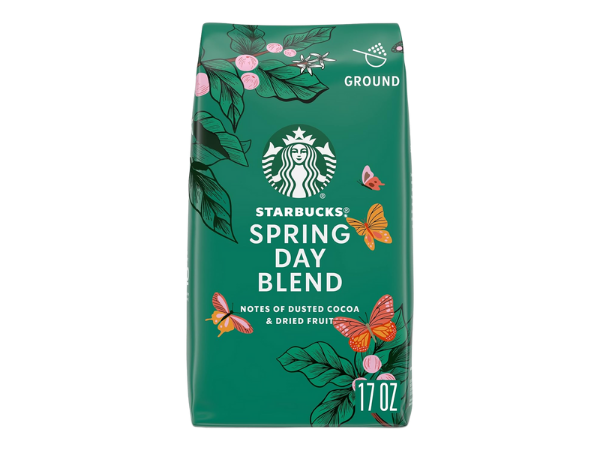
Starbucks Spring Day Blend
Caffeine
95 – 235 mg
Note: Caffeine amounts are based on Starbucks’ standard brewed medium roast coffee, including Spring Day Blend. Actual caffeine can vary depending on brewing strength, grind size, and preparation method.
| Attribute | Value |
|---|---|
| Caffeine Level | Moderate |
| Serving Size | 8 – 20 fl oz |
| Serving Size (ml) | 240 – 591 ml |
| Caffeine | 95 – 235 mg |
| Calories | 5 kcal |
| Sugar | – |
| Caffeine per fl oz | 12 mg/fl oz |
Made from 100% Arabica beans sourced from Africa and Latin America, it offers a balanced flavor profile with notes of cocoa and dried fruit.
What is Starbucks Coffee?
Starbucks is a global coffeehouse brand that has become synonymous with quality coffee and café culture. Founded in Seattle in 1971, the company has expanded worldwide, offering a wide range of beverages, food items, and seasonal blends.
- Global presence with over 30,000 stores.
- Uses 100% Arabica beans for all blends.
- Offers seasonal limited‑edition coffees like Spring Day Blend.
- Known for roast spectrum: Blonde, Medium, Dark.
- Strong focus on sustainability and ethical sourcing.
Starbucks coffee is more than just a drink—it represents a ritual and lifestyle for millions of people.
Flavor Profile and Roast Level of Starbucks Spring Day Blend
Spring Day Blend is a medium roast coffee that balances smoothness with vibrant flavor. Starbucks describes it as a harmonious blend of beans from Africa and Latin America, offering notes of rich cocoa and lush dried fruit.
- Roast Level: Medium roast.
- Flavor Notes: Cocoa, dried fruit, mild sweetness.
- Bean Origins: Africa and Latin America.
- Body: Smooth, balanced, not overly heavy.
- Acidity: Moderate, bright but not sharp.
Its flavor profile appeals to those who enjoy complexity without bitterness, offering a cup that is both comforting and lively.
Caffeine in Starbucks Spring Day Blend by Cup Size
Caffeine levels vary depending on cup size and brewing method. On average, Starbucks medium roasts contain about 95 mg per 8 fl oz (Short) serving, scaling up with larger sizes.
- Short (8 fl oz): 95 mg caffeine.
- Tall (12 fl oz): 150 mg caffeine.
- Grande (16 fl oz): 190 mg caffeine.
- Venti (20 fl oz): 235 mg caffeine.
- Cold brew variations may contain higher caffeine.
Still, Spring Day Blend aligns with Starbucks’ standard medium roast caffeine profile, offering a steady boost without being overwhelming.
Caffeine in Starbucks Spring Day Blend by Espresso Shot
Espresso shots are a concentrated form of caffeine. A single Starbucks espresso shot contains about 75 mg of caffeine, while a double shot (doppio) has ~150 mg.
- Solo (1 shot): 75 mg caffeine.
- Doppio (2 shots): 150 mg caffeine.
- Triple (3 shots): 225 mg caffeine.
- Quad (4 shots): 300 mg caffeine.
Espresso shots are often used as the base for lattes, cappuccinos, and macchiatos, making them versatile for both straight consumption and mixed drinks.
Caffeine Content per Milliliter (ml)
When measured by volume, Starbucks medium roast coffee averages about 12 mg of caffeine per fluid ounce, which equals ~0.4 mg per milliliter. This allows precise calculation for custom servings.
- 1 ml: 0.4 mg caffeine.
- 100 ml: 40 mg caffeine.
- 250 ml (approx. Tall cup): 100 mg caffeine.
- 500 ml (approx. Venti cup): 200 mg caffeine.
This measurement helps consumers track intake more accurately, especially those monitoring caffeine for health or dietary reasons.
Bean Quality and Sourcing Behind Starbucks Spring Day Blend
Starbucks sources beans for Spring Day Blend from Africa and Latin America, regions known for producing high‑quality Arabica coffee. African beans often contribute fruity, floral notes, while Latin American beans add cocoa and nutty flavors.
- 100% Arabica beans.
- African beans: Fruity, floral complexity.
- Latin American beans: Cocoa, nutty balance.
- Ethical sourcing: C.A.F.E. Practices.
- Seasonal limited edition for freshness.
This sourcing strategy ensures Spring Day Blend delivers both flavor and integrity, aligning with Starbucks’ global sustainability goals.
Factors That Influence Caffeine Levels in Starbucks Spring Day Blend
While the blend itself is crafted from medium‑roast Arabica beans, the way it is brewed, served, and consumed can significantly alter how much caffeine ends up in your cup.
- Roast Level: Lighter roasts retain slightly more caffeine than darker roasts.
- Brewing Method: Cold brew extracts more caffeine than drip.
- Grind Size: Finer grinds increase caffeine extraction.
- Water Temperature: Hotter water extracts caffeine faster.
- Serving Size: Larger cups naturally contain more caffeine.
Understanding these variables helps consumers tailor their coffee experience. For example, choosing a cold brew version of Spring Day Blend will yield a stronger caffeine kick compared to a standard drip brew.