
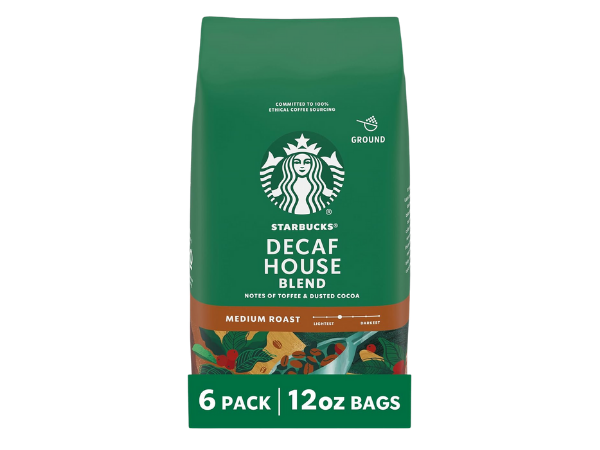
Starbucks Decaf House Blend
Caffeine
10 – 30 mg
Note: Caffeine amounts are based on Starbucks Decaf House Blend brewed coffee. While labeled “decaf,” it still contains trace caffeine, typically 10–30 mg per serving depending on cup size and brewing method.
| Attribute | Value |
|---|---|
| Caffeine Level | Very Low |
| Serving Size | 8 – 20 fl oz |
| Serving Size (ml) | 240 – 591 ml |
| Caffeine | 10 – 30 mg |
| Calories | 5 kcal |
| Sugar | 0 |
| Caffeine per fl oz | 1 – 2 mg/fl oz |
Starbucks Decaf House Blend is a carefully crafted coffee designed for those who enjoy the rich flavor of Starbucks coffee but prefer to limit their caffeine intake.
What is Starbucks Coffee?
Starbucks Coffee is one of the most recognized coffee brands worldwide, known for its consistent quality and diverse offerings. The company sources beans from multiple regions and roasts them to create signature blends that appeal to a wide audience.
- Global Brand – Starbucks operates thousands of stores worldwide.
- Diverse Menu – Offers brewed coffee, espresso drinks, teas, and more.
- Signature Roasts – Includes Blonde, Medium, and Dark roasts.
- Specialty Blends – Seasonal and limited-edition coffees.
- Decaf Options – Available for those limiting caffeine intake.
The Decaf House Blend fits into this framework by providing a familiar taste without the full caffeine load.
Flavor Profile and Roast Level of Starbucks Decaf House Blend
The Decaf House Blend is a medium roast, offering a balanced flavor that is neither too light nor too dark. Its taste is approachable, with notes that appeal to a wide range of coffee drinkers.
- Medium Roast – Balanced between light and dark.
- Nutty Notes – Subtle flavors of toasted nuts.
- Cocoa Hints – Mild chocolate undertones.
- Smooth Finish – Clean aftertaste without bitterness.
- Versatile – Works well black or with milk.
This flavor profile makes the Decaf House Blend versatile for different brewing methods, from drip coffee to French press.
Caffeine in Starbucks Decaf House Blend by Cup Size
Even though it is labeled “decaf,” Starbucks Decaf House Blend contains small amounts of caffeine. The caffeine content varies depending on the size of the cup ordered. Larger servings naturally contain more caffeine, though still far less than regular coffee.
- Tall (12 oz) – Approximately 15–20 mg caffeine.
- Grande (16 oz) – Approximately 20–25 mg caffeine.
- Venti (20 oz) – Approximately 25–30 mg caffeine.
- Short (8 oz) – Approximately 10–15 mg caffeine.
- Trenta (30 oz, iced) – Approximately 30–35 mg caffeine.
These values are significantly lower than regular brewed coffee, which can contain 150–300 mg per cup depending on size.
Caffeine in Starbucks Decaf House Blend by Espresso Shot
Espresso-based drinks made with decaf beans also contain trace amounts of caffeine. Each shot of Starbucks Decaf Espresso contributes a small amount, which can add up depending on the drink.
- Single Shot – Around 3–10 mg caffeine.
- Double Shot – Around 6–20 mg caffeine.
- Triple Shot – Around 9–30 mg caffeine.
- Quad Shot – Around 12–40 mg caffeine.
- Custom Drinks – Vary depending on number of shots.
Compared to regular espresso, which contains about 75 mg per shot, decaf espresso is much lower in caffeine.
Caffeine Content per Milliliter (ml)
Measuring caffeine by milliliter provides a precise way to understand intake. Starbucks Decaf House Blend has a much lower caffeine concentration compared to regular coffee.
- Decaf Brewed Coffee – Roughly 1–2 mg per ounce (30 ml).
- Regular Brewed Coffee – Roughly 10–15 mg per ounce (30 ml).
- Decaf Espresso – About 1–2 mg per 10 ml shot.
- Regular Espresso – About 7–8 mg per 10 ml shot.
- Variability – Depends on brewing method and bean batch.
This measurement highlights the significant reduction in caffeine achieved through decaffeination.
Bean Quality and Sourcing Behind Starbucks Decaf House Blend
Starbucks emphasizes ethical sourcing and quality control in its coffee beans. The Decaf House Blend is no exception, with beans selected to maintain flavor even after decaffeination.
- Ethically Sourced – Starbucks follows Coffee and Farmer Equity (C.A.F.E.) practices.
- Global Origins – Beans from Latin America and other regions.
- Quality Control – Rigorous testing for flavor consistency.
- Decaffeination Process – Preserves natural flavors.
- Sustainability – Commitment to environmentally responsible practices.
The sourcing of beans ensures that the Decaf House Blend maintains the same quality standards as regular Starbucks coffee.
Factors That Influence Caffeine Levels in Starbucks Decaf House Blend
Several factors determine the exact caffeine content in decaf coffee. Understanding these helps explain why caffeine levels may vary slightly between cups.
- Decaffeination Method – Different processes remove varying amounts of caffeine.
- Bean Type – Arabica vs. Robusta beans have different caffeine levels.
- Roast Level – Darker roasts may retain slightly less caffeine.
- Brewing Method – Drip, French press, or espresso affect extraction.
- Serving Size – Larger cups naturally contain more caffeine.
These factors contribute to the variability in caffeine content. While Starbucks provides general estimates, actual caffeine levels may differ slightly.
Health Considerations of Drinking Decaf Coffee
Decaf coffee provides many of the benefits of regular coffee without the high caffeine content. It allows individuals to enjoy flavor and antioxidants while minimizing potential side effects of caffeine.
- Reduced Jitters – Less likely to cause anxiety or restlessness.
- Better Sleep – Lower risk of insomnia compared to regular coffee.
- Heart Health – Contains beneficial compounds without excess stimulation.
- Digestive Comfort – Gentler on sensitive stomachs.
- Suitable for Sensitive Groups – Safer for children, pregnant women, or those with medical conditions.
Drinking decaf coffee can be a healthy choice for those who love coffee but need to limit caffeine. Starbucks Decaf House Blend provides a flavorful option that supports well-being while maintaining the coffeehouse experience.