
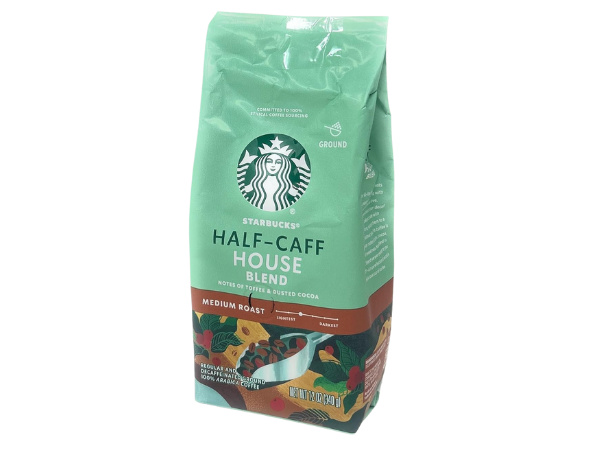
Starbucks Half-Caff House Blend
Caffeine
45 – 115 mg
Note: Caffeine amounts are based on standard brewing of Starbucks Half-Caff House Blend, which combines regular and decaffeinated Arabica beans.
| Attribute | Value |
|---|---|
| Caffeine Level | Moderate |
| Serving Size | 8 – 20 fl oz |
| Serving Size (ml) | 237 – 591 ml |
| Caffeine | 45 – 115 mg |
| Calories | 5 kcal |
| Sugar | – |
| Caffeine per fl oz | 5–6 mg/fl oz |
Starbucks Half-Caff House Blend is designed for coffee drinkers who want the taste and aroma of Starbucks’ signature blends but with reduced caffeine.
What is Starbucks Coffee?
Starbucks Coffee is a global brand recognized for its wide range of roasts, blends, and flavored offerings. Founded in Seattle in 1971, Starbucks has grown into one of the largest coffeehouse chains worldwide, sourcing beans from Latin America, Africa, and Asia.
Defining traits of Starbucks Coffee:
- Global presence with thousands of stores worldwide.
- Wide roast spectrum: Blonde, Medium, Dark.
- Ethical sourcing through C.A.F.E. practices.
- Diverse product range: whole beans, ground coffee, pods, and ready-to-drink beverages.
- Consistent flavor quality across regions.
Starbucks Coffee represents both quality and accessibility. The Half-Caff House Blend extends this tradition, offering a middle ground between full caffeine and decaf.
Flavor Profile and Roast Level of Starbucks Half-Caff House Blend
The Starbucks Half-Caff House Blend is roasted at a medium level, which balances acidity and body. This roast highlights nutty and cocoa notes, making it approachable for a wide range of coffee drinkers.
Flavor highlights of Starbucks Half-Caff House Blend:
- Smooth, balanced medium roast.
- Nutty undertones with hints of cocoa.
- Mild acidity for a clean finish.
- Consistent flavor across brewing methods.
- Suitable for both black coffee and milk-based drinks.
This roast is ideal for those who want the taste of Starbucks’ classic House Blend but with less caffeine.
Caffeine in Starbucks Half-Caff House Blend by Cup Size
Caffeine content in Starbucks Half-Caff House Blend varies by cup size. Since it is half-caffeinated, it contains roughly 50% less caffeine than a regular House Blend. An 8 oz cup averages about 45 mg of caffeine, compared to 90 mg in a full-strength cup.
Approximate caffeine by size:
- Short (8 oz): 45 mg
- Tall (12 oz): 65 mg
- Grande (16 oz): 90 mg
- Venti (20 oz): 115 mg
- Trenta (30 oz, iced only): 140 mg
These values are estimates, as brewing strength and bean ratios can alter caffeine levels. Still, the Half-Caff House Blend provides a moderate boost suitable for those who want energy without jitters.
Caffeine in Starbucks Half-Caff House Blend by Espresso Shot
While Starbucks Half-Caff House Blend is typically brewed, its caffeine can be compared to espresso equivalents. A solo shot (1 oz) of regular espresso contains ~75 mg of caffeine. A half-caff version would deliver about 35–40 mg per shot.
Espresso caffeine breakdown (Half-Caff equivalent):
- Solo (1 oz): 35–40 mg
- Doppio (2 oz): 70–80 mg
- Triple (3 oz): 105–120 mg
- Quad (4 oz): 140–160 mg
This shows how concentrated caffeine can be even in half-caff espresso. Consumers who want flavor intensity without full caffeine may prefer this option.
Caffeine Content per Milliliter (ml)
Measuring caffeine per milliliter provides precision. Starbucks Half-Caff House Blend averages 5–6 mg of caffeine per fluid ounce (30 ml). This translates to roughly 0.18–0.2 mg per ml.
Caffeine density:
- 30 ml (1 oz): 5–6 mg
- 100 ml: 18–20 mg
- 250 ml: 45–50 mg
- 500 ml: 90–100 mg
This metric helps consumers track intake more accurately, especially when brewing larger batches or cold brew variations of Half-Caff House Blend.
Bean Quality and Sourcing Behind Starbucks Half-Caff House Blend
Starbucks Half-Caff House Blend is made from 100% Arabica beans, sourced ethically from Latin America and other regions. Starbucks emphasizes sustainability, farmer support, and environmental responsibility.
Key sourcing practices:
- Coffee and Farmer Equity (C.A.F.E.) standards.
- Partnerships with farmers worldwide.
- Focus on Latin American beans for House Blend.
- Decaffeination methods that retain flavor.
- Long-term sustainability investments.
This ensures that Starbucks Half-Caff House Blend not only tastes smooth but also supports ethical farming practices, making it a responsible choice for consumers.
Factors That Influence Caffeine Levels in Starbucks Half-Caff House Blend
Caffeine levels in Starbucks Half-Caff House Blend can vary due to multiple factors. Roast level, grind size, brewing method, and bean origin all play roles. Since it is a blend of caffeinated and decaffeinated beans, ratios may also influence caffeine strength.
Influencing factors:
- Roast level: Medium roast balances flavor and caffeine.
- Grind size: Finer grinds extract more caffeine.
- Brewing method: French press vs. drip alters strength.
- Water temperature: Hotter water extracts more caffeine.
- Bean freshness: Fresher beans yield higher potency.
Understanding these variables helps consumers adjust their brewing to match desired caffeine strength.