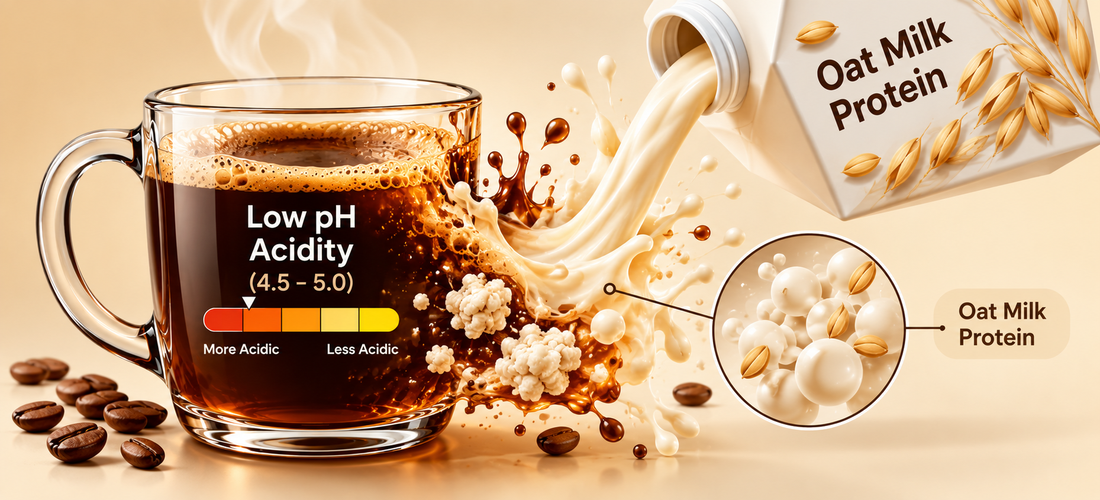
You pour fresh oat milk into your morning coffee, only to see tiny white flakes floating on the surface. Before you throw the carton away, there is something important to know. Oat milk can separate because of the coffee itself, not just because the milk has spoiled.
Coffee acidity, brewing temperature, and the specific oat milk formulation all affect its stability. Fortunately, a few simple adjustments can help you make a smoother, creamier cup without replacing your equipment.
The Chemical Reaction Behind Oat Milk Separation in Coffee
Oat milk is a delicate emulsion of water, oat components, oils, and added minerals. Hot coffee introduces a more acidic environment, which can instantly destabilize that mixture and cause visible flaking. This process is known as coagulation, although it differs from how dairy proteins clump together.
Three main variables drive this visual separation:
- Coffee acidity: Higher acid levels lower the pH balance of the mixture, destabilizing the plant proteins.
- Thermal shock: Sudden exposure to extreme heat causes the plant fats to split.
- Product formulation: Standard formulas lack the necessary buffering agents to survive hot, acidic liquids.
Understanding these variables helps you troubleshoot the drink rather than automatically blaming the freshness of the milk. Managing these external elements allows you to keep your beverage perfectly uniform.
How Acidic Coffee Triggers Oat Milk Separation
Coffee naturally contains strong organic acids, and its acidity varies wildly by origin, roast profile, and brewing method. Light-roasted coffees taste brighter because they retain higher concentrations of chlorogenic and citric acids than dark roasts.
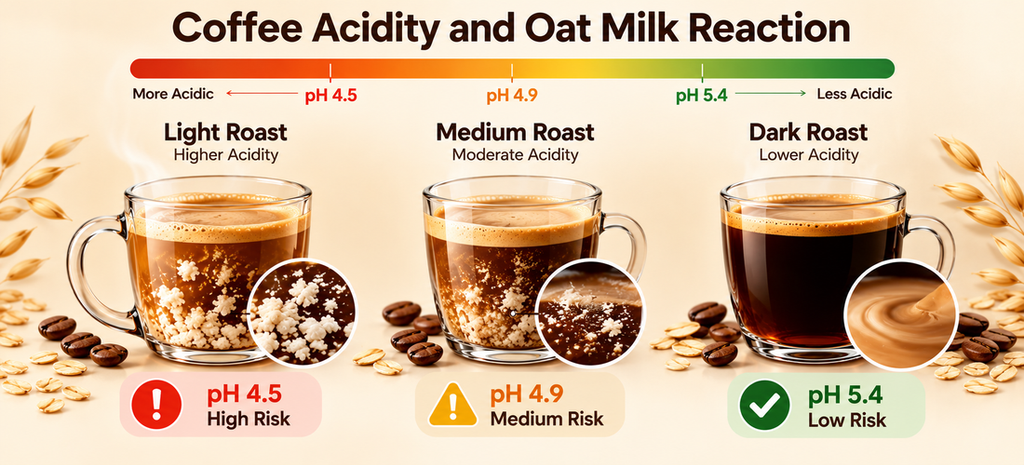
When acidic coffee meets an unstable oat drink, the mixture immediately develops visible flakes. While not every light roast causes this reaction, highly acidic extraction methods accelerate the protein clumping.
The Coffee Acidity Risk Scale:
- 🔴 High Risk (pH 4.5 – 4.7): Light Roasts & Under-extracted Espresso ➔ Instant Curdling
- 🟡 Medium Risk (pH 4.8 – 5.0): Medium Roasts & Standard Drip Coffee ➔ Partial Flaking
- 🟢 Low Risk (pH 5.1 – 5.5): Dark Roasts & Cold Brew ➔ Perfect, Smooth Blend
How to reduce the risk:
- Switch to dark roast: These beans have lower overall acidity, making them much friendlier to plant milks.
- Try cold brew: The cold extraction process pulls significantly fewer organic acids from the coffee grounds.
- Avoid under-extraction: Sour, fast-flowing espresso extractions create a sudden acid wall that triggers instant curdling.
Choosing a coffee bean that complements your alternative milk prevents separation before you even start pouring. Adjusting your roast profile is often the easiest way to solve the issue.
The Role of Temperature in Oat Milk Separation
An extreme temperature gap between cold oat milk and boiling coffee creates intense thermal shock. There is no single temperature threshold where curdling always occurs, but extreme heat accelerates the breakdown of plant emulsions.
Use this simple approach to reduce temperature-related problems:
- Let the coffee rest: Give your espresso or pour-over 30 to 60 seconds to cool slightly.
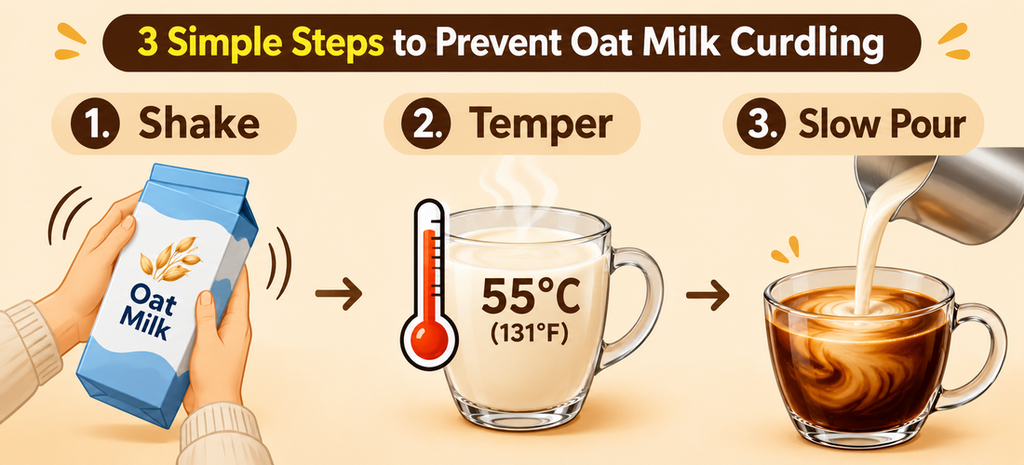
- Warm the milk: Heat your oat milk gradually to around 55°C to 60°C before mixing.
- Pour gradually: Introduce the liquids slowly to avoid a sudden thermal spike.
- Stir gently: Constant motion helps distribute the heat evenly throughout the cup.
Gentler temperature changes reduce one of the most common physical causes of separation. If the flakes continue to appear after cooling your coffee, the issue likely sits with the milk ingredients.
Barista Blend vs. Standard Oat Milk: The Ingredient Difference
Regular oat milk is manufactured primarily for everyday drinking, cereal, and general cold use. Barista oat milk is engineered specifically for hot coffee applications, featuring higher fat content and heat-resistant stabilizers.
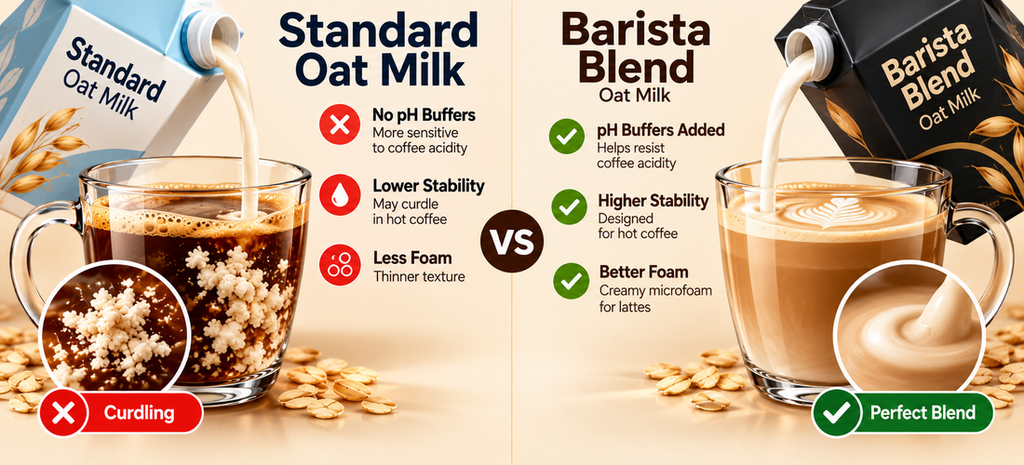
Most professional barista products contain dipotassium phosphate, an essential acidity regulator that buffers the milk against the low pH of coffee. Without this mineral stabilizer, standard plant milks struggle to remain smooth in hot beverages.
| Feature | Standard Oat Milk | Barista Oat Milk |
|---|---|---|
| Acidity Regulators | Usually absent | Dipotassium phosphate included |
| Fat Content | Typically 1% to 1.5% | Higher 2% to 3% from vegetable oils |
| Stabilizers | Minimal or none | Tailored for hot coffee |
| Foam Quality | Dissolves quickly | Creates stable microfoam |
| Best Application | Cold cereal and smoothies | Lattes, cappuccinos, and hot brew |
Looking for the Barista Edition label ensures your milk contains the necessary ingredients to withstand hot coffee. This single product switch can eliminate curdling entirely across all brewing methods.
Step-by-Step Techniques to Stop Oat Milk Curdling
You do not need to change your entire coffee routine all at once. Start with this practical checklist to isolate and fix the exact cause of your oat milk separation.
- Shake the carton: Always redistribute the settled minerals and fats before pouring.
- Reverse the pour: Pour your hot coffee slowly into the oat milk to temper the proteins.
- Use barista formulas: Switch to a brand that uses built-in pH buffers.
- Lower brewing heat: Avoid pouring boiling water above 96°C directly onto your coffee grounds.
- Stir while pouring: Create a vortex in your mug to blend the liquids instantly.
Altering one variable at a time helps you pinpoint exactly what triggers the separation in your specific kitchen setup. Once you find the smooth combination, stick to that precise pouring order.
Water Hardness: Could It Be Affecting Your Oat Milk?
Water hardness refers to the volume of dissolved minerals, specifically calcium and magnesium ions, in your local tap water. While hard water changes your coffee extraction flavor, it can also interact negatively with plant milk stabilizers.
Check your home brewing water if you notice these common warning signs:
- Limescale buildup: White mineral crust forming inside your kettle or espresso machine boiler.
- Chalky coffee texture: A heavy, muted taste profile that overpowers the bean flavor.
- Inconsistent milk blending: The same milk carton behaves differently at home compared to your office.
Using a dedicated water filter reduces excess mineral content and protects your espresso machine plumbing. Optimizing your water quality creates a more stable foundation for all plant-based milks.
Is It Safe to Drink Coffee with Curdled Oat Milk?
Visible separation does not automatically mean oat milk is spoiled, but appearance alone cannot prove that it is safe. Fresh oat milk can split purely due to acid and heat, while an old or improperly stored carton will curdle due to bacterial growth.
If the curdled milk exhibits a sour odor, an unusually thick texture inside the carton, or has been opened for over 7 to 10 days, these signs are highly consistent with spoilage.
How to verify milk safety before brewing:
- Taste the milk alone: Sip a small drop of cold oat milk directly from the carton first.
- Check the expiration date: Ensure the opened package has been refrigerated and used within the manufacturer’s timeline.
- Smell the raw product: Fresh oat milk should have a sweet, neutral, grain-like aroma.
When a fresh, perfectly safe carton splits purely due to coffee acidity, the drink remains completely non-hazardous to consume. However, if you detect any off-flavors or unusual odors from the bottle, discard the milk immediately to protect your health.
FAQ: Quick Answers
Can you fix oat milk once it has already curdled?
No, you cannot reverse coagulation once the proteins have separated. Stirring or reheating will not fix the flakes, so you must adjust your technique for the next cup.
Why does it curdle in espresso but not drip coffee?
Espresso is a highly concentrated shot with a much lower pH level than diluted drip coffee. This concentrated acidity instantly shocks and clumps the plant proteins.
Does microwaving oat milk stop it from separating?
Yes, pre-heating the milk to 55°C eliminates thermal shock. Just avoid boiling it past 70°C, which destroys the plant emulsion completely.