
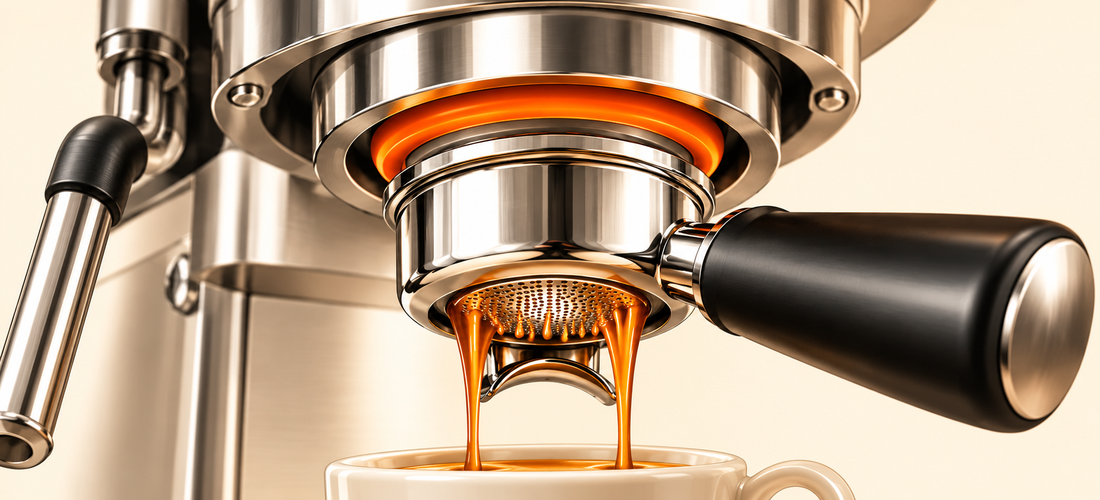
You lock the portafilter and flip the switch, expecting a perfect espresso shot. Instead, hot water and grounds spray over the basket. The problem isn’t a broken machine—five technical variables dictate why water bypasses the seal, and you can fix them at home.
The Core Variable: How the Group Gasket Seal Fails
To stop a leak, understand the group head mechanics. Locking your portafilter presses the basket’s metal rim firmly against a circular group gasket. This component acts as a mechanical barrier designed to withstand water pressure reaching 9 to 15 bars during extraction.
Why the seal fails under pressure:
- Microscopic gaps: Any tiny structural gap allows brewing water to bypass the coffee basket.
- Lost resistance: Water always takes the path of least resistance, shooting sideways instead of down.
Home Fix: Do not use brute force to over-tighten the handle. If a gentle, firm lock does not stop the leak, your gasket has either accumulated debris or reached the end of its operational lifespan.
The Basket Overload: The #1 Cause of High-Pressure Leaks
Packing too much ground coffee into your basket is the most frequent cause of sudden portafilter leaks. Filter baskets are manufactured to hold specific volumetric doses, typically categorized as double (14–18 grams) or triple (20–22 grams).
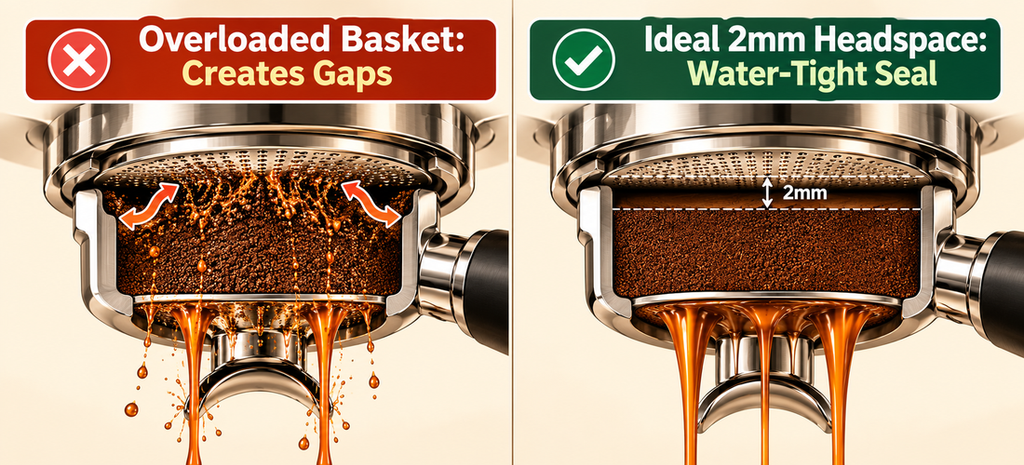
How an overfill triggers a blowout:
- Puck expansion: Dry grounds expand upward by 10% to 15% the moment they absorb hot water.
- Screen interference: An overfilled bed crashes into the shower screen, tilting the portafilter out of its flat, sealed position.
Home Fix: Leave a mandatory 2mm headspace between the coffee bed and the shower screen. Use a coin test: place a coin on your tamped grounds, lock the portafilter, and remove it—if the coin leaves a deep imprint, reduce your dose by 0.5 to 1 gram.
Material Degradation: When Hardened Rubber Destroys the Seal
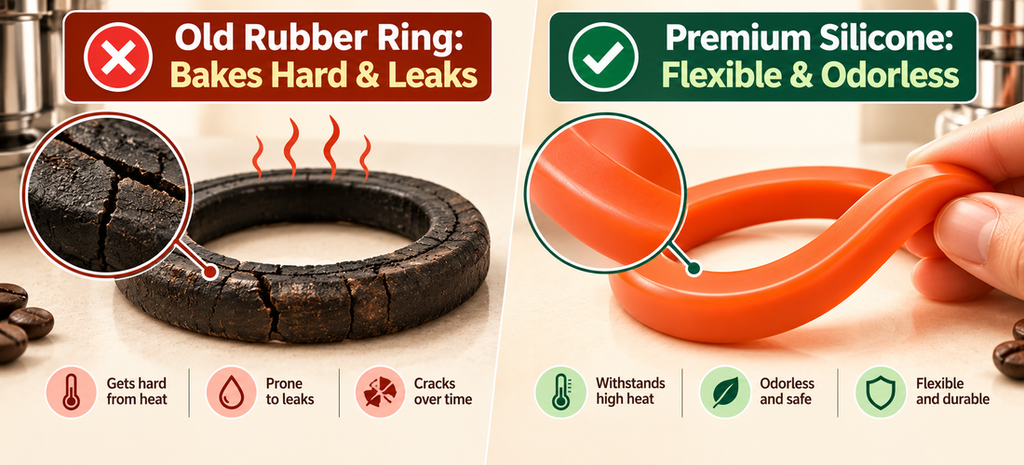
Group gaskets are consumable parts shifting constantly between room temperature and 93°C to 96°C. Over months of thermal exposure, standard black rubber (NBR) undergoes chemical degradation, hardening from a flexible sealer into a brittle, glass-like plastic.
Signs your gasket has failed:
- Loss of elasticity: A healthy gasket feels soft and rubbery; a failing gasket feels completely rock-hard.
- Micro-fractures: High pressure easily rips through the tiny cracks that develop along a hardened ring.
Home Fix: Replace your group gasket every 6 to 12 months. When buying a new one, upgrade to a food-grade silicone gasket—they retain flexibility indefinitely and last up to three times longer than cheap rubber alternatives.
The Rookie Mistake: Leaving Coffee Grinds on the Basket Rim
A leak does not always point to broken hardware; frequently, it is caused by poor bar-handling discipline. When dosing and distribution tools fill your basket, loose coffee particles often spill onto the wide, flat stainless steel top rim.
Why this ruins your extraction:
- The wedge effect: Microscopic grounds act as a physical wedge, embedding into the soft face of your group gasket.
- Micro-channels: These trapped particles open up tiny pathways that allow high-pressure water to jet past.
Home Fix: Cultivate a permanent habit of swiping your index finger around the perimeter of the basket rim after tamping. Ensure the metal-to-rubber interface is entirely clean before engaging the group head.
Incorrect Lock Angle: Engaging the Portafilter Ears
When inserting a portafilter, the handle should naturally lock into place pointing straight toward you at a 90-degree angle (the 6 o’clock position). If your handle stops turning early at a 45-degree angle, the locking ears have not fully climbed the internal ramps.
Why the angle matters:
- Insufficient torque: Stopping early fails to push the basket upward with enough physical force to compress the gasket.
- Uneven wear: Forcing a handle past the 5 o’clock position proves your gasket has worn down too thin.
Home Fix: Check the internal tracks of your group head for dried coffee oils that might block the ears. Ensure both metal tabs slide smoothly into their respective entry points simultaneously.
| Espresso Machine Group / Brand | Standard Gasket Thickness | Common Leak Solution |
|---|---|---|
| E61 Group Heads (Rocket, Lelit) | 8.0 mm | Upgrade to 8.5 mm if ears are worn |
| Breville / Sage (54mm / 58mm) | 8.0 mm | Use custom yellow/blue silicone rings |
| Gaggia Classic Pro | 8.5 mm | Standard 8.5 mm silicone holds 90° lock |
| De’Longhi Dedica | 5.0 mm | Requires proprietary thin-profile seal |
Matching the exact millimeter thickness of your group gasket restores the original factory lock angle instantly. Upgrading to the correct silicone dimensions ensures a water-tight seal without forcing your portafilter handle.
Operating an espresso machine that is actively leaking water under high pressure poses immediate safety hazards. An unstable hydraulic boundary can cause the portafilter to violently blow out sideways from the group head during an extraction.
Why you must stop brewing immediately:
- Scalding risk: Escaping boiling water reaches 95°C, causing severe burns instantly.
- Electrical shorts: Upward spraying water seeps into the internal chassis, risking dangerous short-circuits.
Home Fix: If you see a leak start, abort the pump immediately and wait for the pressure dial to hit zero before touching the handle. Always unplug your machine from the wall outlet before attempting any internal gasket replacements.
The Ultimate Portafilter Leak Troubleshooting Matrix
Fixing a leak does not require an expensive repair budget. Use this quick comparison to see exactly how to diagnose your espresso machine’s sealing issues at home.
| Leaking Symptom | Probable Technical Cause | Instant Home Fix |
|---|---|---|
| Water drips from the sides | Loose grounds on the basket rim | Wipe the rim completely bare before locking. |
| Coffee sprays violently | Overfilled basket crashing into screen | Reduce your dry dose by 0.5g to 1g. |
| Handle turns past 5 o’clock | Gasket has worn down too thin | Replace with a premium silicone gasket. |
| Handle won’t turn to 6 o’clock | Blocked tracks or over-dosed basket | Clean the group head ramps and check headspace. |
| Leak occurs with new gasket | Incorrect gasket thickness or size | Verify the exact millimetres (8mm vs 8.5mm) for your machine. |
Addressing a leaking portafilter immediately protects your equipment from electrical shorts and guarantees a safe home-brewing environment. Consistently maintaining a clean rim and a fresh gasket keeps your espresso extraction perfect.
FAQ: Fast Fixes for High-Pressure Leaks
Can I use a paper filter to stop a portafilter leak?
No, a paper filter will not stop a mechanical leak at the group head. Paper filters sit inside the basket to catch oils, but they cannot fix an issue caused by a worn gasket or an overloaded basket rim.
Why does my portafilter only leak with fine grind sizes?
Finer grinds increase the hydraulic resistance inside the basket, forcing the machine to hit its maximum brewing pressure (9 to 15 bars). This intense pressure tests the weakest points of your seal, exposing a hardened gasket that might not leak with a coarser grind.
How do I know if my espresso machine needs an 8mm or 8.5mm gasket?
It depends on your brand and gasket wear. For example, older Breville or E61 group heads often require an 8.5mm gasket to compensate for metal wear on the locking ears, while newer machines default to a standard 8mm size.
Conclusion: Restoring the Water-Tight Seal
A leaking portafilter is a simple mechanical failure, not a mystery. Once you take control of your basket dosing weight, clear the rim of loose grounds, and replace your hardened rubber gasket with flexible silicone, your home machine will easily handle high-pressure extractions safely.
Ready to master your espresso recipe? Proper basket headspace and dose precision are the absolute foundation of any great shot. Try our interactive Caffeine Calculator to easily check your extraction variables and start brewing barista-level coffee safely today.