
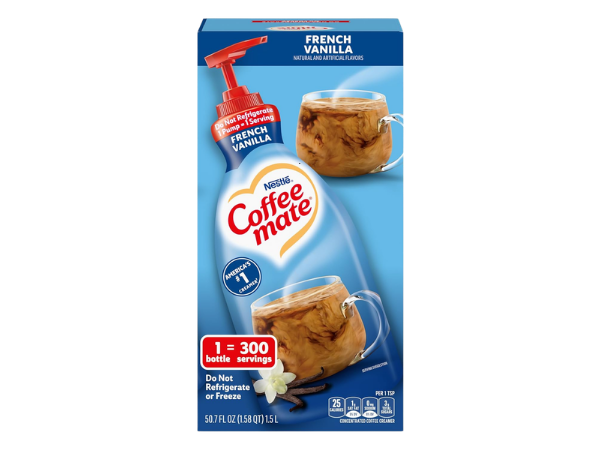
Nestle Coffee Mate Coffee Creamer, French Vanilla
Calories
35 kcal
Note: Nutritional values are based on standard serving sizes listed on Nestlé Coffee Mate packaging.
| Attribute | Value |
|---|---|
| Type | Liquid Non-Dairy |
| Serving Size | 1 tbsp (15ml) |
| Calories | 35 kcal |
| Sugar (g) | 5g |
Nestle Coffee Mate French Vanilla Creamer is one of the most popular flavored creamers on the market, loved for its smooth sweetness and ability to transform a simple cup of coffee into a café-style indulgence.
Overview of Nestle Coffee Mate Creamer
Coffee Mate was introduced in 1961 as the first non-dairy creamer, designed to provide creaminess without the need for refrigeration. Over time, it has become a staple in kitchens and workplaces worldwide.
Key features of Coffee Mate French Vanilla Creamer include:
- Non-dairy formulation suitable for lactose-intolerant individuals.
- Available in liquid and powdered formats.
- Shelf-stable with a long expiration date.
- Sweet vanilla flavor that enhances coffee.
- Widely available in supermarkets and online.
While it delivers flavor and texture, it is important to understand what goes into it and how it affects your nutrition.
Ingredients in Coffee Mate Creamer
The French Vanilla version of Coffee Mate contains a blend of sweeteners, oils, and stabilizers that mimic the creaminess of dairy. While it is labeled non-dairy, it does contain sodium caseinate, a milk-derived protein that is not lactose.
Typical ingredients in Coffee Mate French Vanilla Creamer include:
- Water (liquid version).
- Sugar or corn syrup solids.
- Vegetable oils (such as palm or soybean oil).
- Sodium caseinate (milk derivative, not lactose).
- Mono- and diglycerides (emulsifiers).
- Natural and artificial flavorings.
- Carrageenan (stabilizer).
- Preservatives for shelf stability.
While convenient, the reliance on processed oils and additives has raised questions about whether Coffee Mate is a healthy choice compared to natural dairy or plant-based alternatives.
Calories per Serving: What to Expect
Calories in Coffee Mate French Vanilla Creamer vary depending on whether you use the liquid or powdered form. The liquid version is more common and slightly higher in calories.
Calorie breakdown:
- Liquid French Vanilla (1 tbsp): ~35 calories.
- Powdered French Vanilla (1 tsp): ~10 calories.
- Sugar-free French Vanilla (1 tbsp): ~15 calories.
- Larger servings (3 tbsp liquid): ~105 calories.
While a single tablespoon may not seem significant, frequent use can add up quickly. For example, three tablespoons daily contribute over 100 calories, which can impact weight management if not accounted for.
Sugar Content in Coffee Mate Creamer
Sugar is one of the most important factors to consider when using Coffee Mate French Vanilla. The liquid version contains added sugar, while the powdered form uses corn syrup solids.
Sugar content examples:
- Liquid French Vanilla (1 tbsp): ~5 grams of sugar.
- Powdered French Vanilla (1 tsp): ~1 gram of sugar.
- Sugar-free French Vanilla: 0 grams of sugar (sweetened with sucralose).
- Larger servings (3 tbsp liquid): ~15 grams of sugar.
For individuals monitoring sugar intake, flavored liquid creamers can quickly add up. Using three tablespoons daily adds 15 grams of sugar, which is nearly half the daily recommended limit for women according to the American Heart Association.
Nutritional Profile: Fat, Carbs & Protein
Beyond calories and sugar, Coffee Mate French Vanilla Creamer contains fats and carbohydrates, with minimal protein.
Nutritional highlights per serving (liquid, 1 tbsp):
- Total fat: ~1.5 grams.
- Saturated fat: ~1 gram.
- Carbohydrates: ~5–6 grams.
- Protein: <1 gram.
- Cholesterol: 0 mg.
The fat content comes primarily from vegetable oils, which may include saturated fats. Modern formulations have reduced trans fats, but the product remains processed. Coffee Mate provides creaminess without significant protein or vitamins, making it more of a flavor enhancer than a nutritional contributor.
Popular Flavors of Coffee Mate Creamer
While French Vanilla is the most popular flavor, Coffee Mate offers a wide variety to suit different tastes.
Popular flavors include:
- French Vanilla
- Hazelnut
- Italian Sweet Cream
- Caramel Macchiato
- Pumpkin Spice (seasonal)
- Peppermint Mocha (seasonal)
- Coconut Caramel Latte
- Café Mocha
These flavors allow consumers to customize their coffee experience without additional syrups or sweeteners. Seasonal releases generate excitement, while sugar-free versions cater to health-conscious drinkers.
Health Considerations: Is Coffee Mate Creamer Safe?
Coffee Mate French Vanilla Creamer is safe for most people when consumed in moderation, but its processed ingredients raise health concerns.
Points to consider:
- Contains added sugars that may contribute to weight gain and metabolic issues.
- Vegetable oils may include saturated fats.
- Artificial flavors and stabilizers add to overall processed food intake.
- Sugar-free versions rely on artificial sweeteners.
- Not suitable for those with milk protein allergies (due to sodium caseinate).
For individuals with lactose intolerance, Coffee Mate provides a convenient alternative to dairy cream. However, those seeking whole-food options may prefer plant-based creamers made from almond, oat, or coconut milk.
Final Verdict: Should You Use Coffee Mate Creamer?
Coffee Mate French Vanilla Creamer offers convenience, flavor variety, and accessibility, making it a popular choice for coffee drinkers worldwide. Its non-dairy formulation suits lactose-intolerant individuals, and sugar-free versions provide alternatives for those monitoring sugar intake.
Pros of Coffee Mate French Vanilla:
- Sweet, creamy flavor.
- Shelf-stable and convenient.
- Lactose-free.
- Affordable and widely available.
Cons of Coffee Mate French Vanilla:
- Contains added sugars and processed oils.
- Minimal nutritional value.
- Reliance on artificial ingredients.
In conclusion, Coffee Mate French Vanilla Creamer is best enjoyed in moderation. It enhances coffee flavor and texture but should not be relied upon as a daily staple for those concerned about sugar, fat, or processed ingredients. For occasional indulgence, it’s a satisfying option, but health-conscious consumers may prefer natural or plant-based alternatives.