
This page contains affiliate links. As an Amazon Associate I earn from qualifying purchases.
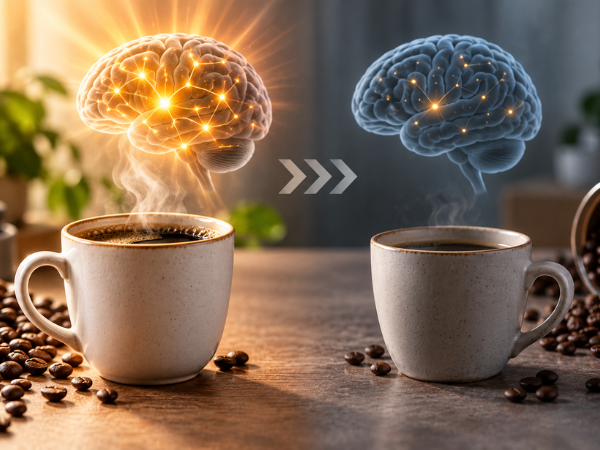
If your morning coffee no longer gives you the same boost it once did, caffeine tolerance may be part of the reason. With regular caffeine consumption, some people become less sensitive to its noticeable effects and may start drinking more to achieve the same level of alertness.
What Is Caffeine Tolerance?
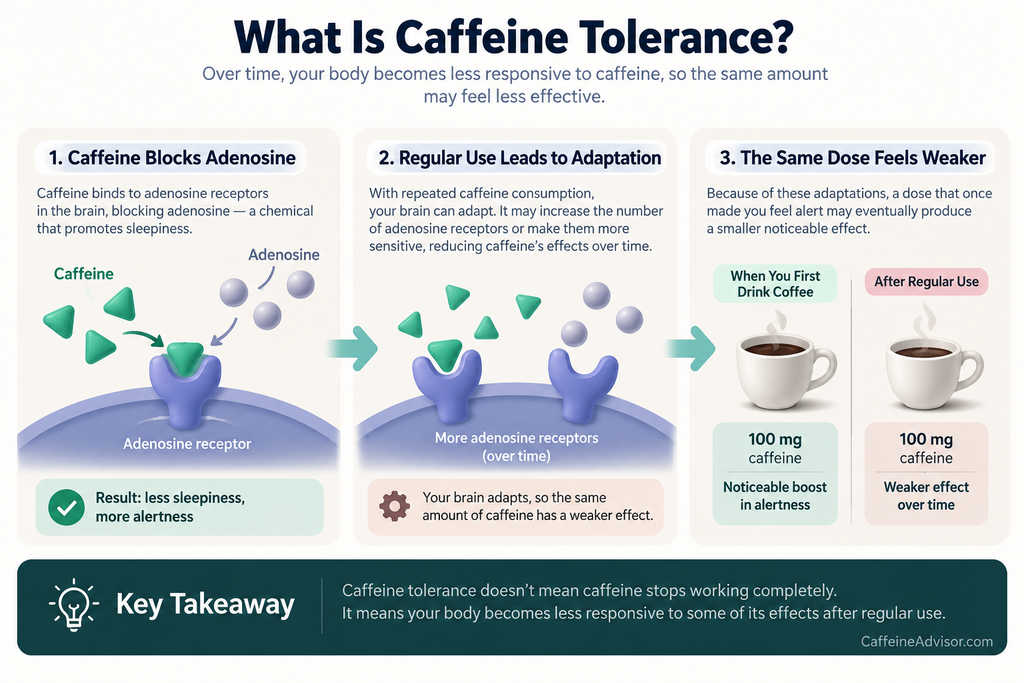
Caffeine tolerance occurs when the body becomes less responsive to certain effects of caffeine after repeated exposure.
Caffeine primarily works by blocking adenosine receptors. Adenosine is a chemical involved in promoting sleepiness, so blocking its action can increase alertness.
With regular caffeine use, the body can adapt to this repeated stimulation. Studies have investigated changes in the adenosine system as one possible mechanism behind caffeine tolerance. PubMed: Biochemical Mechanism of Caffeine Tolerance.
Importantly, tolerance is not necessarily complete. Human research suggests that people can become tolerant to some subjective and behavioral effects while still experiencing other effects of caffeine.
Why Your Morning Coffee Doesn’t Hit Like It Used To
Your first cup of coffee may once have produced a noticeable feeling of energy, alertness, or focus. After regular caffeine use, the same dose may feel much less impressive.
There is another possibility, too: some of the effect you associate with coffee may be the reversal of mild caffeine withdrawal.
For regular caffeine users, going without caffeine can lead to fatigue, sleepiness, difficulty concentrating, and headache. Drinking coffee can relieve those symptoms, which can make it feel as though the coffee is giving you a strong boost.
This can create a cycle:
Caffeine → temporary stimulation → regular use → tolerance or withdrawal → caffeine to feel normal again.
How Your Body Adapts to Regular Caffeine
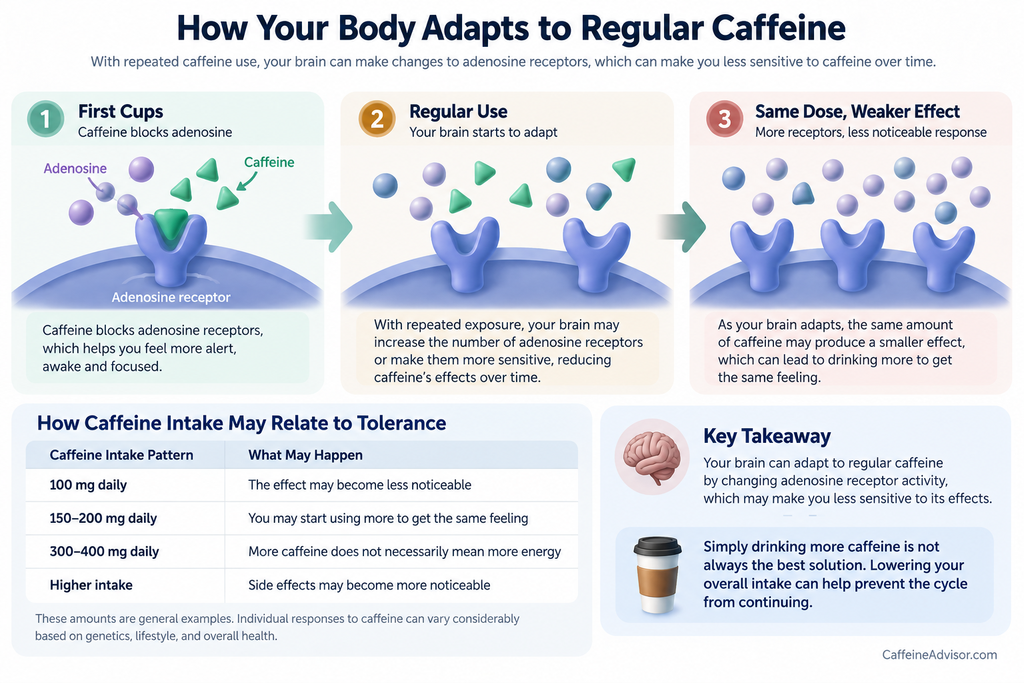
Caffeine interferes with adenosine signaling by blocking adenosine receptors. With repeated exposure, the body can make adaptations to this system.
Research has found changes in adenosine receptor activity following repeated caffeine consumption, although the exact mechanisms of tolerance are complex and are not completely explained by one process. PubMed: Caffeine and adenosine receptors.
This is why simply increasing your caffeine intake may not be the best long-term strategy.
For example:
| Pattern | What can happen |
|---|---|
| 100 mg daily | The effect may become less noticeable |
| 150–200 mg daily | You may start using more to get the same feeling |
| 300–400 mg daily | More caffeine does not necessarily mean more energy |
| Higher intake | Side effects may become more noticeable |
These amounts should not be viewed as specific tolerance thresholds. People respond to caffeine differently, and tolerance depends on factors such as how often you consume caffeine, how much you consume, and how long you have been using it regularly.
The 100 mg Problem: Why You May Need More Caffeine
Imagine that 100 mg of caffeine used to be enough to make you feel alert. After regular use, you might increase your intake to 150 or 200 mg because the original dose no longer feels as effective.
The problem is that this can become a caffeine escalation cycle:
100 mg → 150 mg → 200 mg → 300 mg → “Why am I still tired?”
More caffeine is not necessarily the answer. Higher amounts can increase the risk of unwanted effects such as nervousness, sleep problems, headaches, or a rapid heartbeat.
The FDA says that, for most adults, 400 mg of caffeine per day is an amount not generally associated with negative effects, while also noting that sensitivity varies significantly between individuals. FDA: How Much Caffeine Is Too Much?
The important point is that 400 mg is not a target. Some people may experience unwanted effects at much lower amounts.
What Are the Signs of Caffeine Tolerance?
There is no simple test that tells you exactly how tolerant you are to caffeine. However, several patterns can suggest that your response has changed.
Possible signs include:
- Your usual coffee feels less stimulating.
- You need more caffeine to achieve the same noticeable effect.
- You gradually increase your coffee serving size.
- You consume caffeine mainly to avoid feeling tired or sluggish.
- You feel that one cup is no longer enough.
- You experience headache or fatigue when you skip your usual caffeine.
The last point may indicate caffeine withdrawal rather than tolerance alone. Withdrawal symptoms can include headache, fatigue, reduced alertness, irritability, and difficulty concentrating.
Can a Caffeine Break Reset Your Tolerance?
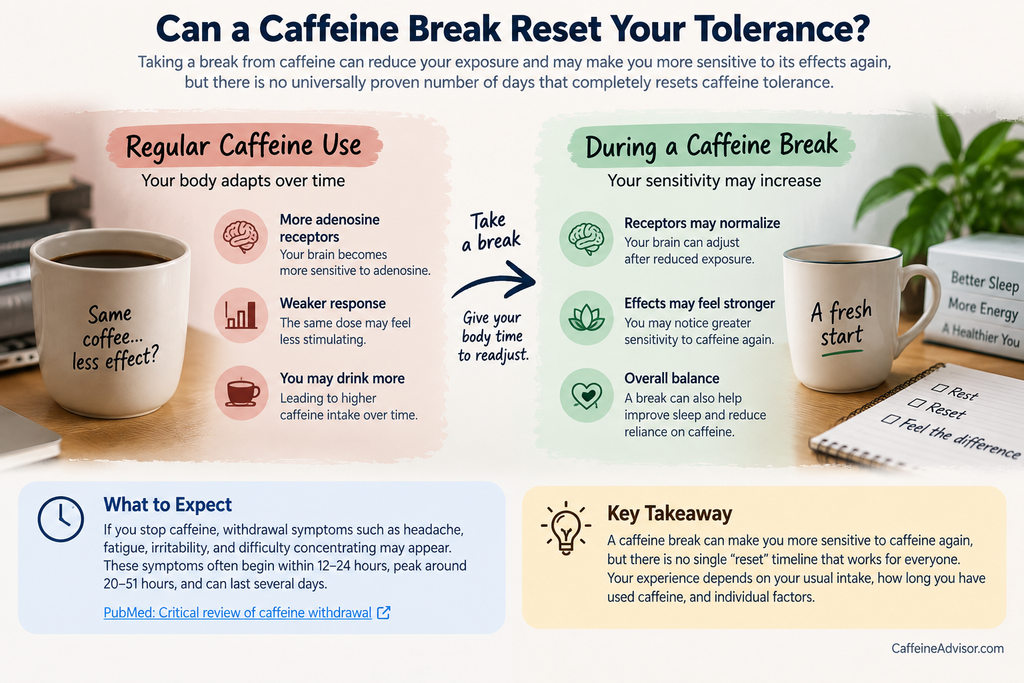
Taking a break from caffeine can reduce your exposure and may make you more sensitive to caffeine again, but there is no universally proven number of days that completely resets caffeine tolerance.
The body begins adjusting after caffeine consumption changes, but tolerance and withdrawal are not identical processes.
If you suddenly stop regular caffeine consumption, withdrawal symptoms may appear. A review of controlled studies found that symptoms commonly begin within 12–24 hours, peak around 20–51 hours, and can last several days.
So a caffeine break can be useful, but it should not be viewed as a guaranteed “reset button.”
How Long Does a Caffeine Reset Really Take?
There is no scientifically established caffeine reset timeline that applies to everyone.
What we do know is that caffeine withdrawal has a relatively predictable pattern for many regular users. Symptoms often begin within a day of stopping caffeine, reach their strongest point during the next couple of days, and generally improve over the following days.
The time needed to feel different after reducing caffeine can depend on:
- Your normal daily caffeine intake
- How long you have used caffeine regularly
- How frequently you consume it
- Your individual sensitivity
- Your sleep and overall fatigue
Therefore, instead of asking “How many days does it take to reset caffeine tolerance?”, it is more accurate to ask how reducing caffeine affects your individual response.
How to Lower Your Caffeine Tolerance Without Quitting Coffee
You do not necessarily need to stop drinking coffee completely to lower your caffeine intake. For many regular coffee drinkers, making small changes to the amount and timing of caffeine can be a more practical approach.
Try reducing your overall caffeine exposure instead:
1. Reduce your serving size
If you normally drink a large coffee, try a smaller serving.
2. Avoid automatically increasing your dose
If one cup feels weaker, adding another cup immediately can reinforce the cycle of increasing caffeine intake.
3. Try half-caf coffee
Mixing regular and decaffeinated coffee can preserve your coffee routine while lowering your caffeine intake.
4. Track your total caffeine
Remember that caffeine can come from more than coffee:
- Tea
- Energy drinks
- Soda
- Chocolate
- Pre-workout products
- Caffeine supplements
- Some medications
5. Consider reducing gradually
If you consume caffeine every day, gradually reducing your intake may be easier than abruptly stopping, particularly if you have experienced withdrawal symptoms before.
6. Pay attention to sleep
Poor sleep can make you reach for more caffeine, which can create another cycle: tiredness → caffeine → poorer sleep → more caffeine.
The goal is not to make caffeine feel extremely strong again. A better approach is to find the lowest amount that provides the effect you actually want.
For most adults, the FDA considers up to 400 mg of caffeine per day generally acceptable, but individual tolerance and sensitivity vary. People who are pregnant, breastfeeding, trying to become pregnant, or taking certain medications should discuss caffeine intake with a healthcare professional.