
This page contains affiliate links. As an Amazon Associate I earn from qualifying purchases.
Caffeine is one of the most widely used stimulants in the world. It is found in coffee, tea, energy drinks, soda, chocolate, supplements, medications, and many other products. For most healthy adults, moderate caffeine consumption can fit into a normal diet.
The U.S. Food and Drug Administration (FDA) cites 400 mg of caffeine per day as an amount that is generally not associated with negative effects for most adults.
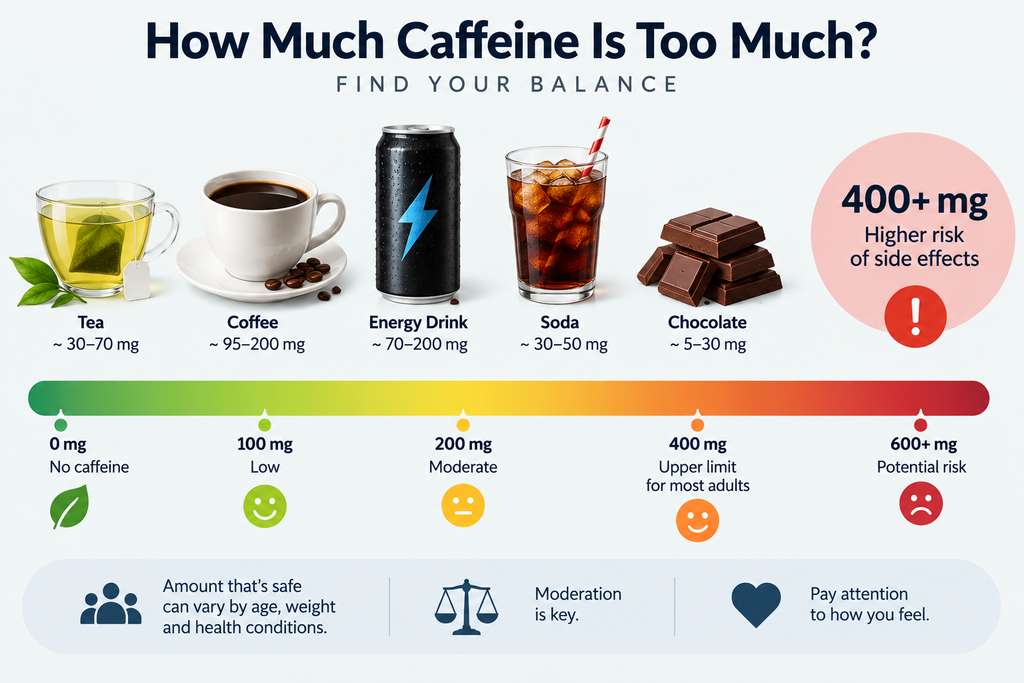
How Much Caffeine Is Too Much?
For most healthy adults, 400 mg of caffeine per day is a commonly used upper reference point.
The FDA notes that this amount is generally not associated with negative effects for most adults, but individual sensitivity varies considerably. Some people may experience nervousness, insomnia, a racing heartbeat, or stomach problems at much lower amounts.
The European Food Safety Authority (EFSA) provides a similar guideline. It considers caffeine intake of up to 400 mg per day from all sources to be of no safety concern for healthy adults. EFSA also considers a single dose of up to 200 mg generally safe for healthy adults.
Quick caffeine guide for healthy adults
| Caffeine intake | General interpretation |
|---|---|
| 0–100 mg/day | Low intake |
| 100–200 mg/day | Moderate intake |
| 200–400 mg/day | Higher but generally within commonly accepted adult limits |
| More than 400 mg/day | Above the FDA/EFSA general adult reference level |
| Very large or concentrated doses | Potentially dangerous |
These numbers are general guidelines, not guarantees of safety. A person who is particularly sensitive to caffeine may experience unpleasant effects well below 400 mg.
Daily Caffeine Limits by Age
Caffeine affects children and teenagers differently from healthy adults, and major health organizations do not recommend treating the adult 400 mg limit as a target for younger people.
The FDA says medical experts advise against energy drinks for children and teens because of their caffeine and sugar content.
Health Canada uses a body-weight-based recommendation for children and adolescents of 2.5 mg of caffeine per kilogram of body weight per day.
Caffeine guidelines by age
| Age group | General guidance |
|---|---|
| Under 2 | Avoid caffeinated beverages |
| Children | Keep caffeine very low; weight-based guidance may be used |
| Adolescents | Limit caffeine and avoid energy drinks |
| Healthy adults | Up to 400 mg/day is the commonly cited upper reference |
| Pregnant adults | Generally limit to 200 mg/day |
| Breastfeeding adults | Discuss individual intake with a healthcare professional |
There is some variation between organizations and countries, particularly for children and adolescents. For that reason, younger people should not simply use the adult 400 mg figure.
Caffeine Limits by Body Weight
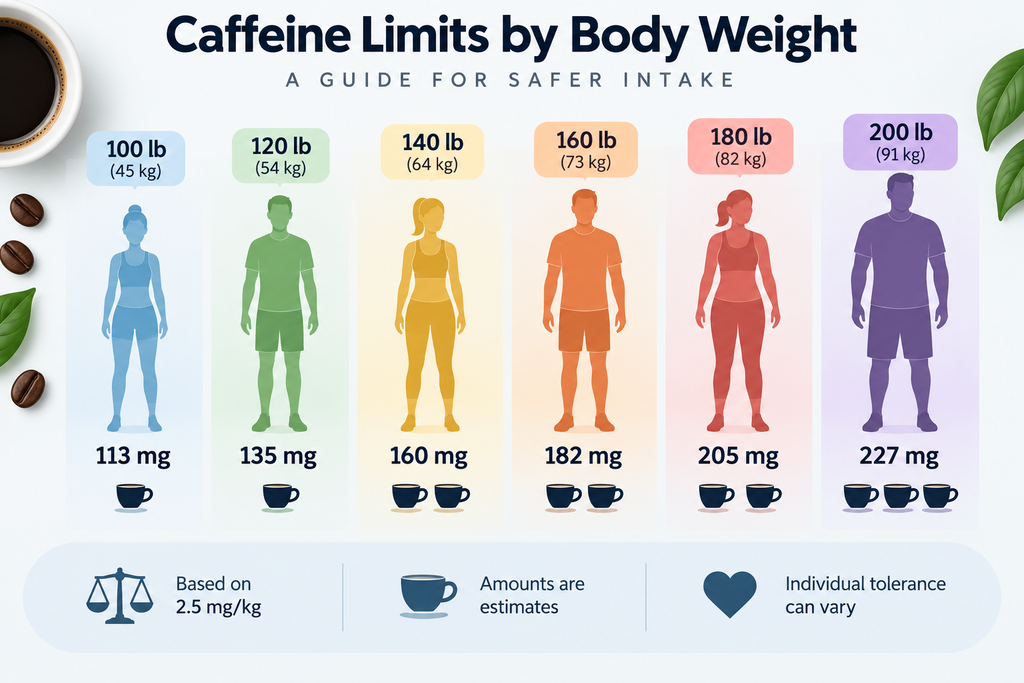
Body weight is another useful way to understand caffeine intake.
EFSA considers a single dose of approximately 3 mg/kg of body weight to be generally without safety concerns for healthy adults. It also gives a daily adult reference of approximately 5.7 mg/kg, corresponding to 400 mg for a 70 kg adult.
Health Canada uses 2.5 mg/kg per day as its recommended maximum for children and adolescents up to age 18.
Example caffeine amounts based on body weight
The following calculations illustrate the difference between adult and child/adolescent weight-based guidelines.
| Body weight | 2.5 mg/kg | 3 mg/kg |
|---|---|---|
| 100 lb (45 kg) | 113 mg | 136 mg |
| 120 lb (54 kg) | 135 mg | 162 mg |
| 140 lb (64 kg) | 160 mg | 192 mg |
| 160 lb (73 kg) | 182 mg | 218 mg |
| 180 lb (82 kg) | 205 mg | 246 mg |
| 200 lb (91 kg) | 227 mg | 273 mg |
| 220 lb (100 kg) | 250 mg | 300 mg |
Important: These calculations should not be interpreted as personalized medical limits. The 2.5 mg/kg figure is Health Canada’s guidance for children and adolescents, while the 3 mg/kg figure is EFSA’s reference for a single caffeine dose in healthy adults.
How Much Caffeine Is Too Much at Once?
Daily caffeine intake is only part of the picture. The amount consumed in a short period also matters.
EFSA considers a single caffeine dose of up to 200 mg, or approximately 3 mg/kg for a 70 kg adult, generally safe for healthy adults.
For example, drinking 400 mg slowly over an entire day is different from consuming 400 mg within a short period.
Large doses taken quickly can produce stronger effects such as:
- Shakiness
- Nervousness
- Rapid heartbeat
- Heart palpitations
- Nausea
- Headache
- Anxiety
- Increased blood pressure
- Difficulty sleeping
The FDA also warns that very high amounts of caffeine can produce serious toxic effects. Rapid consumption of around 1,200 mg can produce toxic effects such as seizures, although individual responses vary.
Caffeine Intake During Pregnancy
The American College of Obstetricians and Gynecologists (ACOG) recommends keeping caffeine consumption below 200 mg per day during pregnancy. ACOG notes that moderate caffeine consumption below 200 mg per day does not appear to be a major contributing factor to miscarriage or preterm birth.
Caffeine can come from more than coffee. When calculating daily intake, include:
- Coffee
- Tea
- Energy drinks
- Soda
- Chocolate
- Caffeinated medications
- Caffeine-containing supplements
ACOG specifically reminds pregnant people that caffeine is present in coffee, tea, chocolate, energy drinks, and soft drinks.
Pregnancy caffeine reference
| Daily caffeine | General guidance |
|---|---|
| 0–100 mg | Low intake |
| 100–200 mg | Within the commonly recommended pregnancy limit |
| 200+ mg | Above the ACOG recommended limit |
If you are pregnant, trying to become pregnant, or have questions about your individual caffeine intake, discuss it with your healthcare provider.
Caffeine Limits by Drink Type
One of the easiest ways to accidentally consume too much caffeine is to underestimate the amount in a serving.
Caffeine levels can vary significantly between brands, serving sizes, brewing methods, and product formulations.
The FDA gives the following approximate caffeine ranges for several 12-ounce beverages: regular brewed coffee can contain about 113–247 mg, energy drinks about 41–246 mg, black tea about 71 mg, green tea about 37 mg, and caffeinated soft drinks about 23–83 mg.
Approximate caffeine content
| Beverage | Typical caffeine |
|---|---|
| 8 oz brewed coffee | 95–200 mg |
| 12 oz brewed coffee | 113–247 mg |
| 8 oz energy drink | 70–100 mg |
| 12 oz energy drink | 41–246 mg |
| 8 oz tea | 14–60 mg |
| 12 oz black tea | About 71 mg |
| 12 oz green tea | About 37 mg |
| 12 oz cola | About 35–45 mg |
| Chocolate | Varies by product |
These are estimates rather than fixed values. The actual caffeine amount can be substantially different depending on the product.
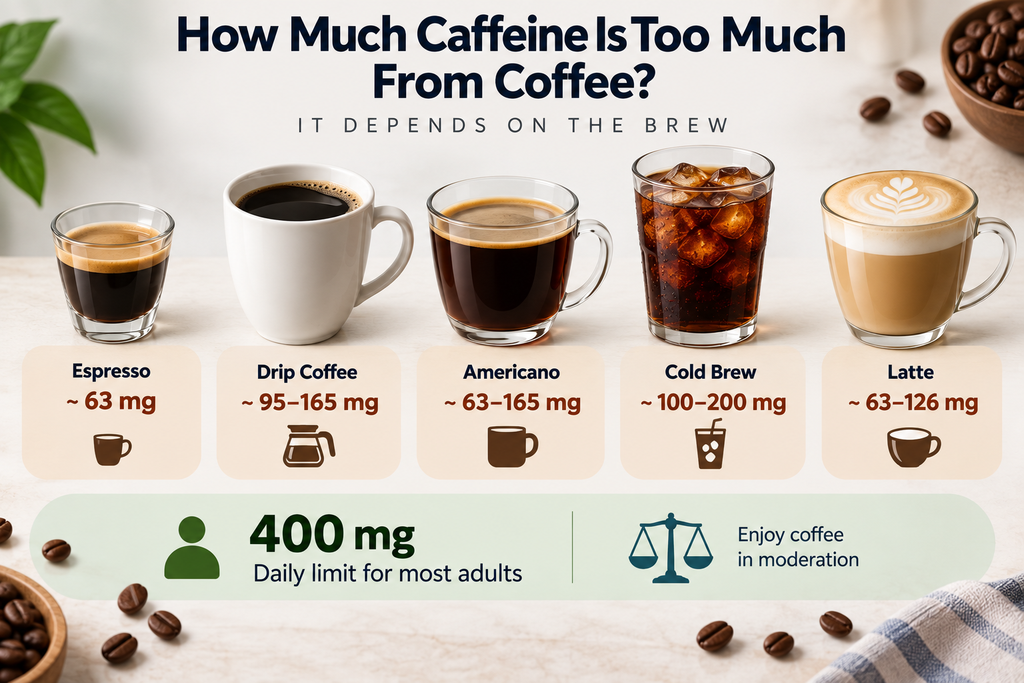
How Much Caffeine Is Too Much From Coffee?
Coffee is one of the biggest sources of caffeine for adults.
The FDA estimates that a typical 12-ounce serving of regular brewed coffee can contain approximately 113–247 mg of caffeine.
That means the number of cups someone can drink before reaching 400 mg depends heavily on the coffee.
Example
If a 12-ounce coffee contains 200 mg of caffeine:
- 1 coffee = 200 mg
- 2 coffees = 400 mg
- 3 coffees = 600 mg
Two large coffees could therefore reach the general daily adult reference level, while three could exceed it considerably.
Coffee size also matters. A “cup” in everyday conversation may mean a large mug, while nutrition and caffeine data often use smaller standardized serving sizes.
How Long Caffeine Stays in Your System
Caffeine does not disappear immediately after you finish your drink.
According to MedlinePlus, caffeine reaches peak levels in the blood within about one hour and its effects may continue for four to six hours.
This is especially important for sleep.
Someone may drink coffee in the late afternoon and still have enough caffeine in their system at bedtime to interfere with sleep.
Factors that can affect caffeine’s effects
The duration and intensity of caffeine’s effects can vary according to:
- Amount consumed
- Time of consumption
- Individual metabolism
- Pregnancy
- Certain medications
- Regular caffeine use
- Individual sensitivity
If caffeine interferes with your sleep, reducing the amount or moving your last caffeinated drink earlier in the day may help.
How to Calculate Your Daily Caffeine Intake
The easiest way to control caffeine consumption is to count all sources, not just coffee.
Step 1: Record everything you consume
Include:
- Coffee
- Espresso
- Tea
- Energy drinks
- Soda
- Chocolate
- Pre-workout products
- Caffeine supplements
- Certain medications
Step 2: Check serving sizes
A container may contain more than one serving.
For example, if a beverage contains 160 mg of caffeine per serving but the bottle contains two servings, drinking the entire bottle provides 320 mg.
Step 3: Add the caffeine together
Suppose your day looks like this:
| Product | Caffeine |
|---|---|
| Morning coffee | 180 mg |
| Tea | 50 mg |
| Energy drink | 140 mg |
| Chocolate | 20 mg |
| Daily total | 390 mg |
Although the individual products may seem moderate, the total reaches almost 400 mg.
Step 4: Compare the total with your personal limit
For most healthy adults, 400 mg/day is the FDA’s commonly cited general reference. Pregnant people should generally stay below 200 mg/day according to ACOG. Children and adolescents require a more cautious approach.
Safe Caffeine Intake Quick Reference
Use this table as a simple starting point.
| Person or situation | General reference |
|---|---|
| Healthy adult | Up to 400 mg/day |
| Healthy adult, single dose | Up to 200 mg |
| Pregnant | Less than 200 mg/day |
| Children/adolescents | About 2.5 mg/kg/day under Health Canada guidance |
| Sensitive caffeine user | May need considerably less |
| Highly concentrated caffeine products | Avoid |
The limits above come from different authorities and are intended for different populations, so they should not be treated as interchangeable. FDA and EFSA provide adult guidance, while Health Canada uses a weight-based recommendation for children and adolescents. ACOG provides pregnancy-specific guidance.
A practical rule
For a healthy adult, staying at or below 400 mg per day is a useful general benchmark. But your personal comfortable limit may be lower.
If you regularly experience jitters, anxiety, palpitations, headaches, or sleep problems after consuming caffeine, consider reducing your intake rather than trying to reach the maximum guideline.
The Bottom Line
For most healthy adults, up to 400 mg of caffeine per day is the commonly cited general limit from the FDA and EFSA. However, “too much” depends on more than the number on a label.
Age, body weight, pregnancy, medications, medical conditions, timing, and individual sensitivity can all change how caffeine affects you.
The most useful approach is to:
- Track caffeine from all sources.
- Check serving sizes carefully.
- Pay attention to how your body responds.
- Avoid treating 400 mg as a daily target.
- Use lower limits for pregnancy and younger age groups.
- Avoid pure or highly concentrated caffeine products.
When in doubt, especially if you take medications, have a medical condition, are pregnant, or experience significant symptoms after caffeine, talk with a healthcare professional about an appropriate intake for you.
Sources & References
This guide is based on caffeine intake guidance from leading health authorities, including the U.S. Food and Drug Administration (FDA) , the European Food Safety Authority (EFSA) , and the American College of Obstetricians and Gynecologists (ACOG) .