
This page contains affiliate links. As an Amazon Associate I earn from qualifying purchases.
A built-in grinder makes it easier to brew coffee from freshly ground beans without needing a separate grinder. Among the different grinder designs, flat burr grinders are valued for their consistent particle size and precise grinding.
What Is a Flat Burr Grinder in a Coffee Machine?
A flat burr grinder uses two flat, parallel grinding discs with sharp cutting surfaces. Coffee beans pass between the burrs and are ground into smaller, more uniform particles.
Key Features of Flat Burr Grinders:
- Consistent grinding: Produces relatively uniform coffee particles.
- Adjustable grind size: Useful when dialing in different beans.
- Compact design: The grinder is integrated into the coffee machine.
- Fresh grinding: Beans can be ground immediately before brewing.
Flat burr grinders are commonly found in automatic espresso machines and some specialty coffee machines.
Best 8 Coffee Machines with Flat Burr Grinders
The following models represent different approaches to built-in flat burr grinding, from compact automatic machines to more feature-rich espresso systems.
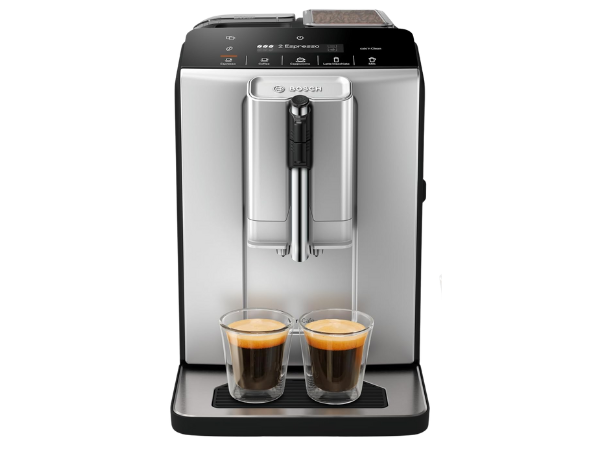
Bosch 300 Series VeroCafe
The Bosch 300 Series VeroCafe is a compact fully automatic espresso machine designed for straightforward everyday brewing.
Key features:
- Ceramic built-in grinder
- 3 grind adjustment levels
- 5 beverage options
- Milk Express system
- Touch control panel
- Removable brewing unit
Its smaller number of grind settings may appeal to users who prefer a simple setup rather than frequent adjustments. The removable brewing unit also makes routine maintenance easier.
Gaggia Anima Coffee and Espresso Machine
The Gaggia Anima combines automatic espresso preparation with a built-in ceramic grinder and traditional milk frothing.
Key features:
- 100% ceramic grinder
- 5 grind settings
- 5 Optiaroma strength levels
- 15-bar pump
- Classic stainless-steel Pannarello wand
- Removable brew group
The Anima is a good fit for someone who wants the convenience of an automatic machine but still enjoys manually texturing milk.

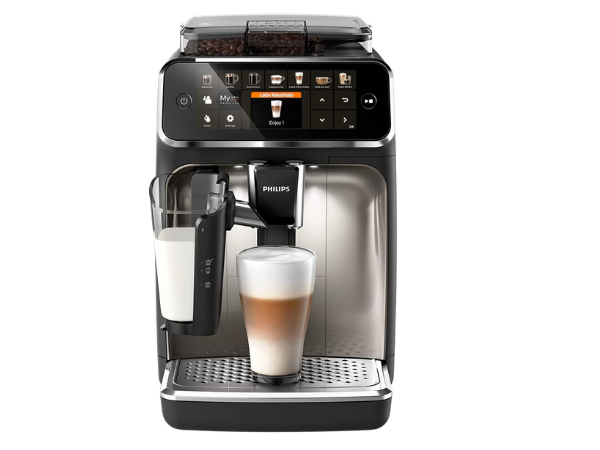
Philips 5400 Series LatteGo
The Philips 5400 Series LatteGo is built around variety and customization. It offers 12 preset coffee drinks, a 12-level grinder, four user profiles plus a guest profile, and the LatteGo milk system.
Key features:
- 12-level ceramic grinder
- 12 preset beverages
- LatteGo milk system
- 4 user profiles plus guest
- 275 g bean hopper
- 1.8 L water tank
Its combination of drink variety, adjustable strength, temperature control, and saved profiles gives it considerably more personalization than simpler automatic machines.
Bosch VeroCafe 500 Series
The Bosch VeroCafe 500 Series moves beyond the basic automatic format with a ceramic flat burr grinder and six grind settings.
Key features:
- Ceramic flat burr grinder
- 6 grind settings
- Up to 10 beverage options
- 5 coffee-strength levels
- 2.5-inch TFT color display
- Automatic cleaning and descaling
The VeroCafe 500 is a useful middle ground for people who want more adjustment than the 300 Series without moving into a much more complicated coffee setup.

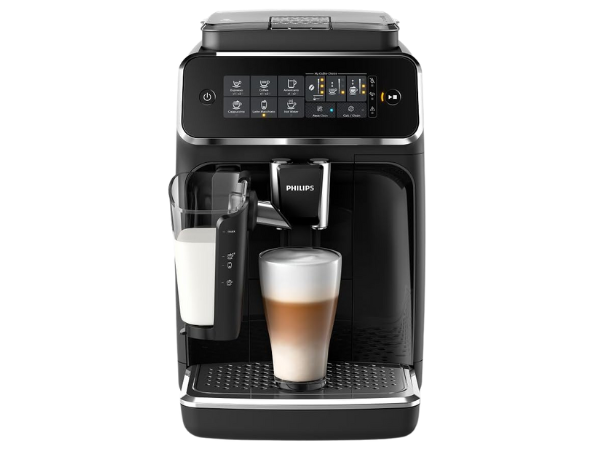
Philips 3200 Series LatteGo
The Philips 3200 Series LatteGo keeps automatic coffee preparation relatively simple while still providing useful control over the grind. Its ceramic grinder has 12 settings, while the LatteGo system is designed for quick setup and cleaning.
Key features:
- Ceramic grinder
- 12 grind settings
- LatteGo milk system
- 5 coffee beverages
- One-touch preparation
- Easy-to-clean milk system
The 3200 makes sense for users who want the benefits of freshly ground beans without a long learning curve.
Gaggia Magenta Prestige
The Gaggia Magenta Prestige combines a built-in ceramic grinder with a front-mounted milk carafe and a wide selection of automatic beverages.
Key features:
- 100% ceramic grinder
- 5 grind settings
- 5 Optiaroma strength levels
- Integrated milk carafe
- Full-color TFT display
- Removable brew group
The Magenta Prestige is designed for users who want a broad menu without giving up control over coffee strength.

Philips 4300 Series LatteGo
The Philips 4300 Series LatteGo sits between the simpler 3200 and more advanced 5400 in Philips’ lineup. It features a ceramic grinder with 12 settings, eight coffee beverages, a touchscreen interface, and two user profiles plus a guest option on supported versions.
Key features:
- 12-step ceramic grinder
- 8 coffee beverages
- LatteGo milk system
- 2 user profiles plus guest
- Touchscreen display
- Aroma Extract brewing system
The 4300 is a sensible choice for households that want more personalization than the 3200 provides but do not need the larger drink menu of the 5400.

Gaggia Cadorna Prestige
The Gaggia Cadorna Prestige is one of the more customizable machines in this group. It uses adjustable ceramic grinders with 10 grind selections, five Optiaroma intensity levels, four user profiles, and an integrated milk carafe.
Key features:
- 100% ceramic grinder
- 10 grind settings
- 5 Optiaroma strength levels
- 4 user profiles
- Integrated milk carafe
- 15-bar pump
The Cadorna Prestige is particularly interesting for households with several coffee drinkers because individual profiles can store personalized beverage settings.

How Does a Flat Burr Grinder Affect Coffee Flavor?
The grinder has a major influence on extraction because grind size determines how quickly water interacts with the coffee.
A flat burr grinder is designed to produce a relatively consistent grind. When particles are more uniform, the brewing process can be easier to control.
This can be particularly useful for espresso, where small changes in grind size can noticeably affect extraction.
However, the grinder itself does not automatically make coffee taste better. Bean freshness, roast level, brewing temperature, dose, water quality, and extraction time also have a significant impact.
Flat Burr vs. Conical Burr: Key Differences
Flat and conical burrs both have advantages, and the difference is not simply a matter of one being better.
| Feature | Flat Burr | Conical Burr |
|---|---|---|
| Burr shape | Two flat discs | Cone-shaped burr inside a ring |
| Grind consistency | Generally very consistent | Also capable of consistent grinding |
| Heat management | Depends on grinder design | Often efficient at lower speeds |
| Grind adjustment | Often precise | Often precise |
| Common use | Espresso and specialty coffee | Espresso and automatic machines |
| Machine size | Can require more space | Often compact |
For an integrated coffee machine, the overall grinder design matters more than the burr shape alone. Burr quality, motor, adjustment range, dosing system, and the machine’s brewing system all contribute to the final result.
How Many Grind Settings Are Enough?
There is no single ideal number of grind settings. What matters is whether the machine gives you enough control for the coffee you normally drink.
For basic automatic coffee preparation, 3–5 settings may be sufficient. If you regularly change beans or want to fine-tune espresso extraction, 8–12 or more settings can provide greater flexibility.
A Simple Guide:
- 3–5 settings: Good for straightforward everyday brewing.
- 6–8 settings: More flexibility for different beans.
- 9–12 settings: Better for users who like to fine-tune extraction.
- 12+ settings: Useful when you want more precise control.
Remember that the number of settings is only one part of the equation. The actual adjustment range and the machine’s ability to make noticeable changes between settings are equally important.